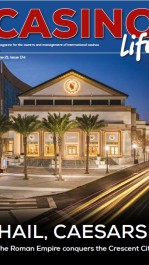


How Gaming & Leisure Properties parlayed a handful of casinos into an empire. What does its future hold? By David McKee
Tucked into quiet, rural Wyomissing, Pennsylvania is a powerhouse of the casino industry. They’re not the players one commonly thinks of in the gambling world but Gaming & Leisure Properties Inc. (GLPI) has amassed enormous clout without raising its voice. Starting as a spinoff of Penn Entertainment in 2013, the real estate investment trust, or REIT, began with Penn’s real estate holdings but has become much more than an investment single-purpose real estate holding company of its progenitor.
In early 2014, GLPI snapped up Casino Queen in East St. Louis and has steadily marched up the casino food chain, reaching the foot of the Las Vegas Strip. GLPI recently added its 69th property, purchasing New Mexico racino Sunland Park, adding to one of the gaming industry’s farthest-flung portfolios, ranging from the Tropicana Atlantic City to M Resort outside Las Vegas.

Image: Ameristar St. Charles, Missouri
It would be impossible to discuss GLPI and not mention the elephant in the room, Bally’s Corp. When the latter couldn’t fully finance $1.7 billion megaresort Bally’s Chicago, GLPI stepped in with two-thirds of the funding, construction oversight and a property redesign. The REIT also owns the Tropicana Las Vegas site, upon which Bally’s hopes to erect a $2 billion megaresort, as well as right of first refusal on $4 billion Bally’s New York, should that proposal be tapped by the Empire State’s government.
We spoke with GLPI President Brandon Moore last month. Our conversation spanned everything from the latest business developments to why GLPI has not diversified outside the casino/racino industry. The discussion has been edited for length.
Congratulations on the Sunland Park acquisition. How did it come together?
Sunland Park has been in the market for the better part of six years. We first looked at it and offered on it in 2019. Due to a number of complications, a lot of failed processes, it came back to market more recently. We were already familiar with the asset. We had a tenant that had a relationship with the seller and the deal finally came together. It was something that we knew was a good, stable, cash-flowing property. The EBITDA has been pretty consistent in the many years that we’ve looked at it. It was a nice property to add to the portfolio.

Image: Brandon Moore, President, GLPI
What is the likelihood of serious competition?
It would be foolish to say there’s no chance of competition in the El Paso market. The western part of Texas is less likely to have a large facility, if there’s gaming expansion in Texas, which I think there eventually will be. There are some threats in New Mexico. There’s a dormant racing license there and some efforts now to move a license to Clovis. Clovis will impact Hobbs – Zia Park, which we also own – more than it will Sunland.
We recently profiled new Hollywood Joliet. What was GLPI’s role in making it happen?
We owned the prior Joliet location, so when Penn came to us and wanted to relocate that facility, under our lease it necessarily came through us. Because they needed to have some sort of permission to move that facility without doubling up the rent. We agreed to extract the old Joliet facility upon the opening of the new one and we also agreed to fund the hard costs on the new site. So we own the land and the building of the new Joliet.

Image: Zia Park, New Mexico
Could you describe your partnership with Penn Entertainment? It seems to be more than landlord/tenant, something more creative.
As you’re aware, Penn is our predecessor. We spun out of Penn, so we have a long relationship. They still are in excess of 60 percent of our overall rent. Penn is our largest tenant, by far. There was a point in time when we diversified with Pinnacle Entertainment. Then Penn bought Pinnacle and put those portfolios back together. Penn has done transactions away from us. They’ve done two properties with our competitor at Vici Properties. So it’s not as if we have a unique pipeline into Penn that others don’t have.But we’ve been supportive over the years, so they continue to be an important partner for us – probably more complex than your typical landlord/tenant, just because they are over 60 percent of our rent. We own a majority of their properties and it’s a substantial majority.
We are by far their largest creditor and you saw that in Covid. Penn came to us when all their properties were shut down and there was a real likelihood that they would not be able to pay the rent. Being their largest creditor, by a wide margin, we were in the best position to bring a solution to bridge the gap for them. That’s when we took the Tropicana in Las Vegas as rent credit.
How many other capex projects do GLPI and Penn have in progress and how are they doing?
The only two left in that development agreement are Aurora, which was a relocation project in Illinois, and Columbus Hotel, which was an addition of a hotel at the Columbus property in Ohio. Both of those are well underway. Penn has announced the second quarter of 2026 for delivery. We are funding the hard costs at Aurora up to $225 million. We have offered up to $70 million for the hotel in Columbus but they have not decided whether or not they want our money for that.

Image:Bally’s Las Vegas (proposed)
Does heavy concentration in one market, St. Louis for instance, ever become problematic?
It hasn’t to date. The only time that becomes problematic is if more supply comes in and you have an Atlantic City-type situation where the market will only support a limited number of facilities. If you own them all and something’s gotta go under, has to be cannibalized, by definition it’s going to be yours, right? The risk you run of having so many facilities in one market (quite frankly, all six of them) is if there’s a deterioration in that market. Your tenants are going to feel that, one way or the other.
The good news for us is it’s differentiated between tenants in that market. We have six facilities in the market but we have several different tenants. We have Boyd Gaming, Penn, Casino Queen, all in that market and that definitely helps to defray that risk.
What criteria go into GLPI’s selection of an investment?
That’s becoming more and more complicated. One of the most important factors for us is the market. We’ll do demographic studies and figure out how stable is it, what are the chances of new competition coming in, who are the players in that market. Right after that, as we start to price things, we’ll look at the EBITDA and make sure the leases have an adequate amount of coverage. The biggest risk to the OpCo/PropCo model is if you put too much rent on the tenant and the rent outpaces the revenue. Eventually that model becomes strained and there’s a risk your rent needs to be decreased to keep the tenant relevant.

Image: Peter Carlino, Chairman & CEO, GLPI
Because of that, we seek to write things at two-times-covered or higher. That gives the tenant a lot of room. The other piece of that is escalation. We took a lot of criticism, coming out of Covid, for not using Consumer Price Index-based escalators. The reality is gaming revenues have not kept up with CPI. Therefore, if you put CPI escalation on an already-stressed lease, you just put it under further pressure. We’re very, very careful to underwrite with a high degree of coverage and an economic structure that we believe the tenant can sustain.
Unlike Vegas, where you can charge $50 for a steak, then $70, then $100 because that’s driving your revenue, in regional gaming it’s mostly the slot machines. You can tweak your hold but you can’t really raise the price. You can’t force people to put more money in and get less money out. Regional gaming has to be focused on the customer and your ability to maintain market share.
What’s the status of Bally’s Chicago and when do you expect it to be completed?
Bally’s Chicago is going along quite well. They had some hiccups in the beginning, for reasons that aren’t all that surprising when you’re undertaking a large-scale project. Right now, it’s coming out of the ground. There are three or four cranes on-site, erecting steel. That is now going along according to schedule and we’re optimistic about the completion. Bally’s has publicly said [it will be ready in the] fourth quarter of 2026. All I can tell you is we expect to be funding into 2027. It’s not meant to be cryptic: Bally’s could open the casino floor in advance of the hotel or they could open it all together. But we believe there will be hard-cost funding from us, going into 2027.
When GLPI commissioned a redesign of Bally’s Chicago, what changes were made?
There were quite a few changes made. Bally’s had gone down to 100 hotel rooms. We thought it was important to have the full 500 rooms on the site, because of the nature of the facility and the overnight-stay business, the convention-type business that may be demanded there. We encouraged them to reorient the property. I say “encouraged them” because we didn’t mandate these things. But parking was across the street. Now parking is layered into the facility so customers can drive onto the property and into the parking garage, go straight into the casino. Never have to step foot outside. Same for employees.
We felt all that was important for the operation of the facility and the customer experience. We encouraged them to move the porte-cochere and the hotel lobby closer to the parking so the customers didn’t have as far to walk. We encouraged them to open up the river. The river was really blocked off. The current design brings in the river. They’ll have the ability for boats to come in and tie up. There will be some F&B offerings that embrace the river into the facility. It was really just maximizing the utility of the site and improving the customer experience.
Given the GLPI is shouldering two-thirds of the cost and overseeing construction, what role does Bally’s play?
Bally’s is the developer, so we are riding shotgun on construction. Obviously, when they come to us and are seeking payment for incurred hard costs, we’re at the payouts, the scope, the progress, making sure things are on budget – and still on the milestone-and-construction schedule we’ve been provided. We are not running the project. Bally’s is running the project. We have folks that are monitoring, both internal and external resources, just to ensure that we know what’s going on at all times, that we are comfortable with where we are in the budget.

Image: River City, St. Louis
How seriously do you take Bally’s recently announced timeline for redevelopment of the Tropicana site, starting in April, and will it be finished before their lease expires?
We believe Bally’s will begin that construction in the timeline they’ve provided. The key question is: How much of that project is done by opening day? The Athletics are planning to have Opening Day in 2028. How much of that project Bally’s has up and constructed by 2028 is somewhat of an unknown. We’re still working with them.
Certain portions will have to be done concurrent with the stadium, because to get in and build in that tight of an envelope, with Las Vegas Boulevard and Tropicana Boulevard situated there – some portion of that project will have to be done concurrently with the construction of the stadium, which is going up now. That’s why I say I believe their timeline for April 2026 is real. There will be improvements in the infrastructure going into that. What will be open at first pitch is still unknown.
CEO Peter Carlino has said GLPI might well participate in Bally’s Las Vegas and Bally’s New York, if the latter is approved. What form might that participation take?
I’ll do the easy one first. In Las Vegas we own the land and we have indicated to Bally’s that we would do $175 million of funding. Peter has been pretty clear that we might do more. As Bally’s pulls together their master plan, with F&B and retail, hotel size, casino, sports book and entertainment, GLPI will consider expanding that capital. Bally’s has a lot of capital needs there. There is an opportunity for GLPI to invest more in that project.
What we really need to see is the income-producing things Bally’s is bringing to that site that can support our rent. Because the one thing we don’t want to do is commit a lot of dollars to the project that will increase rent to the point where it’s not an economically viable project for Bally’s to run on the site. It’s a little bit of a needle to thread. The more revenue-generating opportunities Bally’s brings to the site, the more investment dollars GLPI could conceivably put in, at a cap rate and coverage level that we’re all comfortable with.
The less things that they open, the less GLPI will be willing to put in, just because we are looking for stability over the long term. We don’t want to be renegotiating rent in Year Five or Year 10. It’s going to have to be a project that works for Bally’s and for GLPI. We’re a little early to know how much rent that project can support.
… and New York?
New York is different. If you’ll look at the opportunity set, you look at the demographics, the population density, the number of machines that will be there to service that market. Even with three facilities, it’s likely still an underserved market. As long as you don’t overbuild, the opportunity to make money is going to be very, very strong. You’re really going to have to overbuild to lose money in that market, because the opportunity is that good.

Image: Horseshoe St. Louis, Missouri
GLPI will focus primarily on the land ownership and potentially some or all of the hard costs. You’re talking about multi-billion dollars of project. I don’t think you’ll see GLPI commit to 100 percent of the hard costs. In other words, I don’t think we’re $3 billion into a $4 billion project. Could we do the land and a portion of the hard costs? Sure. That’s completely possible. It depends on Bally’s needs. There will be no trouble finding financing for New York. There are people coming out of the woodwork that want to be a part of funding those facilities.
I don’t think Bally’s will have any trouble finding the capital they need. We’ll figure out how GLPI fits into their long-term capital needs in that project. We do have a right of first refusal with Bally’s and I’m not saying that they can’t find financing that’s competitive with what we’d be comfortable with – it’s completely plausible. But we are very prepared to take a long and hard look at New York, if that opportunity arises with Bally’s … or potentially others. If Resorts World or somebody else wants to monetize a piece of their property to pay their $500 million license fee or something, we’ll be having those conversations as well.
What market or property has been GLPI’s most pleasant surprise?
That’s a very interesting question. It’s so funny you say that. We focus so much on the risks and potential downside that we don’t think as much about the sustainability of the upside. If you look at Charles Town, West Virginia, that’s been very strong. Through the course of time when we were all at Penn, it’s a very, very profitable, good project. Hollywood Toledo has been a great project, if you just look at cash-on-cash return and the sustainability.
There are a few and they’re kind of sneaky. They’re things that are in more stable markets, that haven’t had a ton of competition, that generated a higher ramp and greater cash flow than people expected. Resiliency is the hallmark of a really strong property these days.
Is Chicago a marquee property?
We think yes. We think Chicago will be a fantastic asset. It will be a crown jewel. It will be a must-see destination. But it has a ton of competition and it probably has more risk associated with it than some of these smaller projects that are in markets that are just not going to see competition. They’re not all equal and having them in master leases with guarantees is obviously important to us, because then some of the properties that are more sustainable, stronger and durable can support the deterioration of properties that see increased competition. When you have single-asset leases, the thing stands on its own. We do continue to focus on cross collateralization and packaging properties to know you get the benefit of diversification across those portfolios. That is something we value pretty highly.
What manner of non-gaming investment has GLPI contemplated or is looking into now?
Contemplated a lot of different things. We’ve contemplated leisure-adjacent things, like golf courses, ski resorts and bowling alleys. Those have all traded at cap rates that would be dilutive to us or neutral and haven’t been interesting for those reasons. We haven’t reached a point where we don’t have opportunities in gaming and had to go out and diversify ourselves in a way that could be dilutive. And none of those presented a platform for growth that we thought was worth doing a risky or neutral deal. It hasn’t been in our DNA.

Image: Hollywood St. Louis, Missouri
What makes a gaming REIT a good investment?
It’s the durability of the cash flows that are these triple-net leases. You’re looking at underlying assets that are critical to state infrastructure budgets. They are generating tax dollars that are critical to state operating budgets and therefore the long-term viability of those properties is very important to the states. Letting a state be a key partner in keeping your tenant healthy and afloat is a very powerful thing.
If you look at the durability of our cash flows in the triple-net space – and I mean Vici and GLPI – and if you look at our multiples, I would suggest that these investments are undervalued. You look at where we’re trading now and the durability of these leases, where we were before Covid, where we were after Covid, and where our tenants sit, it is a much safer investment than people realize.
If you want to invest in gaming but gaming makes you nervous, we are gaming but we’re at the top of the capital stack. We’re getting paid before everybody else because we own the building and the land. If you want a safer investment and exposure to gaming, you start with the REITs. You don’t end with them.
Casino Life Magazine would like to thank Brandon Moore, President, GLPI and his PR Team for all their help and assistance with this interview.
*** This exclusive interview was originally published in December 2025 edition of Casino Life Magazine Issue 183 ***